Thursday, 29 June 2017

Day 24 Kisvarda to Vaja

I walked along roads and sandy tracks lined with trees today, much of it in the rain.
As I left Kisvarda the route was again beside a busy road, but this time walking on a cycle path. Later the route diverted onto a quieter road through the village of Anarcs, followed by the village of Gyulahaza. The highlight of Gyulahaza is a MiG 21 rising out of a rose garden. Apparently a memorial to the first Hungarian astronaut,  Bertalan Farkas, who was born in the village, although the bust next to the jet plane is of Yuri Gagarin.
Then it was a walk along sandy tracks between locust trees to the village of Rohod to the sound of thunder rumbling as the skies darkened. Curiously, I saw little lightening, and the thunder seemed mixed with the more regular thumps of artillery practice. As black clouds gathered I thought it wise to eat the lunch I had bought this morning. Inevitably on starting a piece of pizza bread heavy rain began to fall. It continued to fall at a fluctuating intensity for the next few hours and I was glad of a comprehensive set of waterproofs (jacket, trousers and rucksack cover) as the temperature dropped and I started sliding on saturated sand.
Eventually the rain cleared and I reached the vicinity of the Osto Vendeghaz (where I booked to stay) at 4:00 pm, an hour before I had told the owner. I called him and said I would be in a nearby "Bufe", basically a small bar. Here I managed to get a beer and even better a free Palinka.  The men seated in the bar were curious about what I was doing (few British people reach this area), so when the helpful Vendeghaz owner arrived, who spoke some English, I answered various questions he translated - where was I from, how far did I walk each day and how heavy was my rucksack (quite heavy as I was carrying the means to make an evening meal)?
The Vendeghaz is a sort of little holiday home by a lake with reeds and ducks, a bit untidy and neglected. As a "welcome drink" the owner had given me another glass of Palinka. Although the taste is different its effects reminded me of an occasion when I had too many vodka toasts in Russia. Some time after you have drunk it, you start to feel not quite in control. Consequently after cooking a sort of cassoulet from a tin supplemented with bread and tomatoes, I bedded down for an early night.
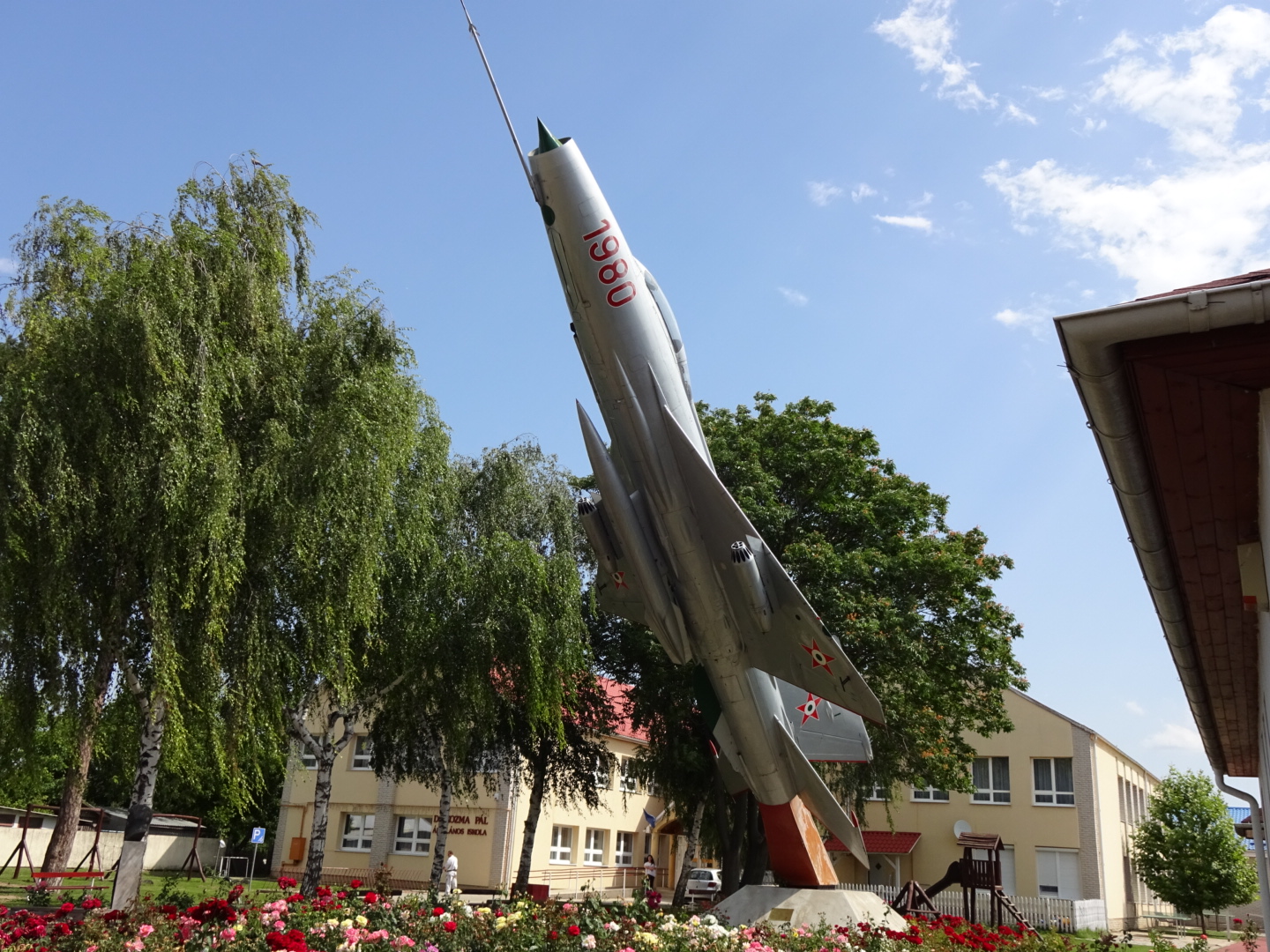
Mig21 in village of Gyulahaza

Sandy tracks through trees

Lake at bottom of my Vendeghaz

Wednesday, 28 June 2017

Day 23 from a field before Cigand to Kisvarda

My night was not as peaceful as I expected as someone was riding a motorcycle up and down the farm tracks late into the evening. There were also sounds of a tractor doing something, thankfully not cutting the grass in the field I was camping in.
Today had some beautiful sections. After struggling through some overgrown and clearly rarely used sections I reached one of the straight drainage ditches that are presumably responsible for changing the landscape from a swamp into large areas of farmland. These drains, the straight tracks beside then, the big fields of wheat with no hedges and the occasional copses reminded me of the Fens and the area south of Wisbech where I have two cousins. One difference was a flock of sheep cropping the grass on the banks of one of the drains and looking fat and healthy on it. They were escorted by a shepherd and his two dogs of indeterminate breeding. The dogs raced up to me barking aggressively, I stood my ground turning to avoid them getting behind me, various sources had indicated that such sheepdogs can be very protective. The shepherd shouted commands at the dogs, waved his stick and walked towards me. After the usual exchange in which I explained I was a stupid English person who did not speak Hungarian I checked (with hand gestures) that it was OK to pass through his flock so as to continue on my route. He said "Egen" (yes) so I slowly moved through his flock trying not to disperse the sheep, then moved steadily away while the dogs mounted a rearguard fit of barking. Shortly after I disturbed a deer which ran off and then stopped and turned around as if to check what I was, then it trotted off on its way.
After Cigand (and a stop to buy my breakfast of Pepsi and a slice of what might have been meant to be Pizza) the path followed the northern embankment of the Tisza river. The river was invisible behind trees until I later crossed it. This is one of Hungary's great rivers. I hope to be joining it again when I enter Serbia on a later part of my walk, with I expect a similar landscape. The land had been almost perfectly flat but south of the Tisza the soil turned sandy and there were low hills, ancient sand dunes maybe. Crops were being irrigated as I passed. For the final section of the day the path followed a drain lined with willow, poplar and elder. It reminded me of a picture by Constable. My presence disturbed ducks which flew into the air catching the wind above the trees. I also disturbed herons and group of storks.
The conurbation of Varos and Kisvarda is a reasonable sized town with a ruined castle, pedestrianised area and a rather nice coffee and cake shop. I am now at the Parish Bull hotel, where the decor may be a bit "over the top" for many people's taste, but where I have nevertheless enjoyed beer and dinner.

Bridge over the Tisza

Tisza river

Path beside a drainage canal before Kisvarda

Day 22 Satoraljaujhely to between Pacin and Cigand

Not such a great night as people were talking in loud voices in a room nearby until after midnight. Today however was my first day on the Alfoldi Kektura or Great Plains Blue route. As expected there were not any hills to climb for a change.
After breakfast it was into town to stock up at the Coop, then out of town following the familiar blue and white waymarks. Sadly the first half of the day was walking beside a busy road with heavy lorries passing. I do not remember such a long stretch of busy road on the E4 since southern Spain. There were two distractions on this lengthy section, firstly police, their car hidden among trees, pulling cars over, secondly, some kind of archaeological park with lots of carved posts and other markers. There were a few signs which appeared to describe what was found at this site, it appeared to date from Arpad times when the Hungarians first invaded the area. It was hot with limited shade so I stopped at the first "bufe" I saw and had a sort of non-alcoholic lemon shandy - very refreshing as it was not too sweet. I tried the same at the next Bufe I saw but accidentally got the alcoholic version, but only 1.5%.
After the long road section there was a welcome detour on farm tracks to the south of the main road, then another detour through a muddy, mosquito infested area to the north, which took the path right to the Slovak border. The path heads south after the village of Pacin. After following very straight farm roads the Kektura turned into a highly overgrown section besides some woods. As it was 6:00 pm I decided to stop and camp on an area of flattened grass in the field next to the woods, maybe used as a campsite before. As the grass was a few feet high I thought it unlikely that anyone would see me and my tent, so settled down to what I hoped would be a quiet evening.

Busy road out of Satoraljeujhely

View back towards Satoraljeujhely and some of the mountains that I crossed on the Blue route 

General comments on Blue route (Kektura) east of Budapest

In reviewing the Blue route from Budapest the first and most obvious thing to say is that there are a lot of trees, invariably beech, oak or locust trees, but with willows in wetter areas. Coniferous trees were rare. Trees are very nice but they do spoil the views, fortunately there are several look out towers (kilato) on the  route so you can see magnificent panoramas over the top of the trees. There are also several ruined castles. Where significant parts are still standing they have excellent views over the surrounding countryside, all the better to detect signs of an attacking force.
Secondly, there is a lot of climbing, more than I expected. The hills may not be that high, but the total ascents each day can be similar to those when I walked across Switzerland,  Bavaria and Austria on the E4 long distance footpath.
Thirdly, in June there were lots of mosquitoes and other insects which left me with lots of itchy bites. They made evenings wild camping an unpleasant experience. Together with the heat it made walking in March (when I walked the western part of the Blue route) a much more pleasant option.
Fourthly, in June the profusion of flowers of many colours in the meadows and alongside tracks were a delight with butterflies and bees (acceptable insects) sampling their nectar. I occasionally sighted deer and wild boar. I saw a woodpecker close up for the first time and storks in the latter part of the walk, many other birds sang to me from first light at 4:30 a.m. to last light at around 10:00 p.m..
Fifthly, the paths were well marked with blue and white waymarks on trees and posts and various signs. Paths were only occasionally overgrown with no sections of busy road and only rare muddy sections. Accommodation was more difficult to find compared with when I walked the western half of the Blue route, perhaps because after Visegrad the path goes through smaller places, villages rather than towns. In consequence I did quite a bit of wild camping. There were Vendeghaz that I could have used. These are usually self contained rooms in a building with the owner living somewhere else, so you can't simply drop by and ask for a room. Hungarians would simply ring up to book, but if you cannot speak Hungarian you have two options. One is to use Booking.com or Revngo.com, a Hungarian booking site in English. Unfortunately, many Vendeghaz are not on these sites and even using Revngo.com you are often asked to contact the owner after making a reservation to arrange at time of arrival. You can deduce other Vendeghaz exist from sites such as www.kektura-szallasok.hu or gotohungary.com/accommodation. The other option is email, you can use Google translate to produce a Hungarian version of a request for a reservation. However the exchange of emails takes time and advance planning, which reduces flexibility.
Finally, for someone from the UK, walking the route is a chance to enjoy all things Hungarian. Food has been an interest since my early childhood. In Hungary I enjoyed cold fruit soups, the little dumplings, fresh water fish like carp, outlaw soup not to forget the more famous goulash. In the shops, restaurants and little bars, everyone was friendly and helpful despite my language difficulties.

Monday, 26 June 2017

Day 21 Makkoshotyka to Satoraljaujhely

I woke to the gentle rhythm of light rain, which fell intermittently all morning before reaching downpour strength for the last 2 hours of my walk. In a period of no rain I had removed my waterproof trousers, trying to look as stylish as some passing hikers. A mistake as my hiking trousers soon became saturated by the wet vegetation and stayed that way once heavier rain forced me to put my waterproofs back on.
My final day on the original Blue route (or more accurately the Országos Kéktúra) was similar to many others, walking through deciduous trees, down the main street of a village of single storey houses, up and down hills with some wicked climbs near the end. The ascents and descents were particularly treacherous as the rain had turned the surface of the path into greasy mud, making my progress slow, nervous and wobbly.
Around 1:30 pm I reached Satoraljaujhely, having left the main Kektura 45 minutes beforehand. At Satoraljaujhely I start on the Alfoldi Kektura, or the Great Plains Blue route. The Alfoldi Blue route was created much later and despite signs outside, the local tourist office appeared unaware of it, or maybe I did not make myself clear when I asked if they had any information on it or accommodation on route.
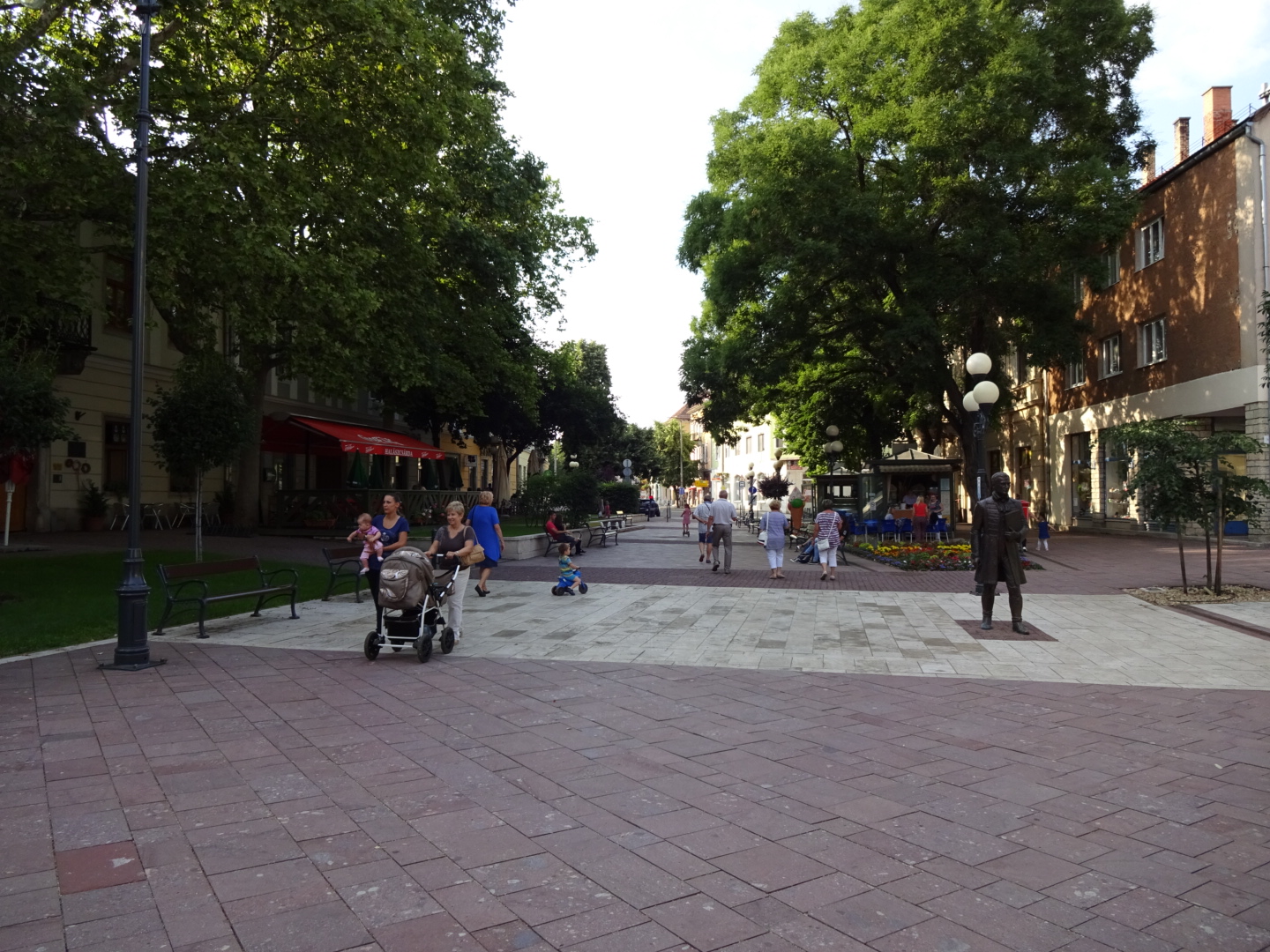
I have settled into the Berg Panzio and eaten a meal in town on the main, tree lined pedestrianised street, watching the girls and boys sitting on benches on opposite sides of the street (to my mind the lads had the sharpest haircuts, some barber around here is handy with the clippers). My guidebook was a bit dismissive of Satoraljaujhely, a border town next to Slovakia, but it has a sort of faded grandeur, with occasional buildings decorated with classical motifs and missing rendering.
I am now sat in the bar of the Panzio have a "Grouse" whisky to celebrate the end of one Kektura and the start of another.

A final walk through woods on the Kektura

The pleasant pedestrianised centre of Satoraljauhely

Day 20 Arka to a hill between Regec and Makkoshotyka

Today it was back to climbing through beech and oak, although the gradient of the climbs was generally not excessive as the path often followed valleys, gradually gaining height. The stream in the main valley consisted of a chain of stagnant pools (ideal for mosquitoes) in a stony riverbed. The local rock appeared to be volcanic.
Today's highlight was Regec castle (Regec Var in Hungarian). It involved a steep climb off the main path but as I missed Boldogkovaralja castle yesterday I was determined to visit this one. In addition to the ruined walls and astounding views (made more astounding as you usually see very few views through all the trees), there was an interesting set of posters (with English translations) describing the development of firearms as well as what the Chief Stewart did. Even better the castle had a Bufe where I could get a coffee without which I imagine I am prone to headaches caused by caffeine withdrawal.
A little further in the village of Regec I was so pleased to find another Bufe open I had a second coffee, an orange juice (good for you) and an ice cream (well I needed the calories as my trousers are getting very loose) which I enjoyed while watching a cartoon on TV with English subtitles.
Then it was more climbing surrounded by trees, passed two abandoned Turistahaz's. I stopped early as yesterday had been a long one. To minimise mosquito attacks I am camped in a fire break on top of a hill. I checked there were no insects before settling down for tea on a fallen tree trunk. Now there are lots of ants around me, picking up crumbs of stale bread roll and walking around with them in an apparently random fashion, possibly for my amusement as I finished with an apple.

A walk in the woods

Regec Castle

Day 19 Irota to Arka

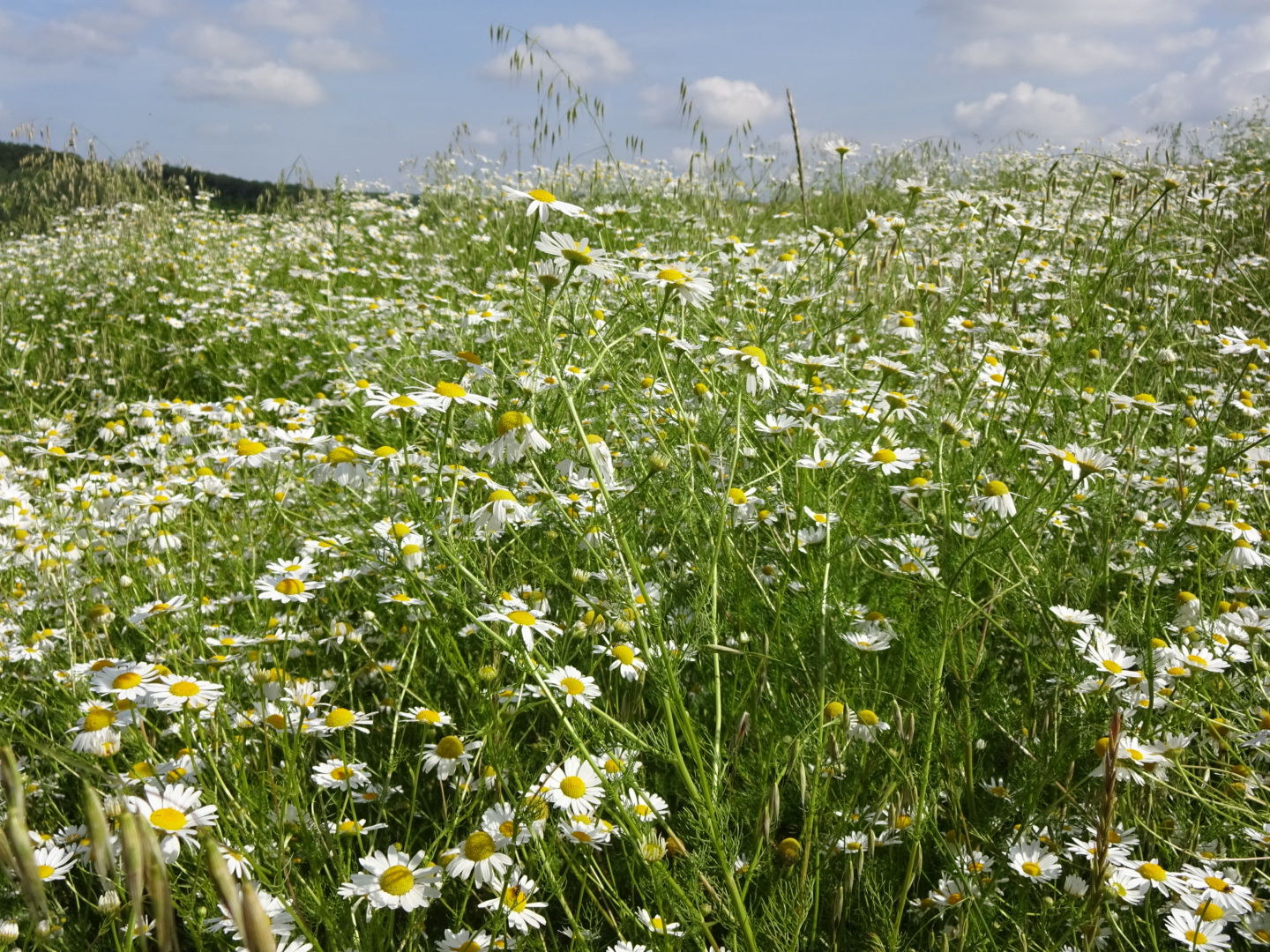
Today the walk was mainly across farmland, past fields of wheat and barley, maize and sunflowers, the paths lined with camomile daisies and scattered with red poppies. There were a few patches of woodland, notable for their muddy tracks.
At the first village I stocked up with food, tomorrow being Sunday and many shops closing from midday Saturday. Unlike the usual "supermarket" style arrangement, this shop was more old fashioned with the goods behind the counter so you had to ask for them. Though I say it myself I did rather well asking for and pointing to what I needed, another few years walking around Hungary and shopping will be a doddle.
Through the next few villages and most of the rest of the day I found myself repeatedly approaching the same two girls from behind, quite unintentionally I must add. I would pass them as I walked a little faster, then I would miss a turn (the problem with farmland is there are no trees to paint waymarks on). In the meantime the girls would get ahead of me (paying more attention to the correct route) and I had to pass them again. Then I diverted to visit a Kilato, they did not and so passed me. I then caught up with them again. This happened a few more times as I stopped for a Coke or a rare coffee and cake. Embarrassing, as I am sure they must have thought I was deliberately following them, but I lacked the Hungarian to make light of the matter. The coffee and cake shop was a pleasant discovery as it was well hidden behind frosted glass so no one could see any surreptitious cake eating. I think the clue is looking for signs saying "Cukrászda" (cake shop).
I had hoped to find accommodation in the Encs area. There was plenty when I planned the trip but online they were all reporting "sold out". I called at two places and they confirmed this, in the second place in the village of Boldogkovaralja they were settling out tables for around 200 people so I presume some big event was on.
Not wanting to entirely miss out on the pleasures of fixed accommodation I had a meal at a local "Bufe" and then headed out beyond where the houses and cemetery ended in the nearby village of Arka, pitching my tent in a quiet corner of some forgotten field.

Walk over farmland, note the big fields

Flowers at the edge of a cornfield

So many lovely daisies